

National Space Society header banner
Space Settlement:    ORBITAL    MOON    MARS    ASTEROIDS    ROADMAP    L5 NEWS    NASA

Eros rotation
The near-Earth asteroid Eros is 33 kilometers long (from NASA NEAR Mission)
 

Asteroids

If the dinosaurs had a space program,
they would still be here.


As an example of the economic value of space resources, let's consider the smallest known M-type asteroid, the near-Earth asteroid known as 3554 Amun (two kilometers in diameter): The iron and nickel in Amun have a market value of about $8,000 billion, the cobalt content adds another $6,000 billion, and the platinum-group metals add another $6,000 billion.
           — John S. Lewis, Mining the Sky.


There are two things you need to know about asteroids:

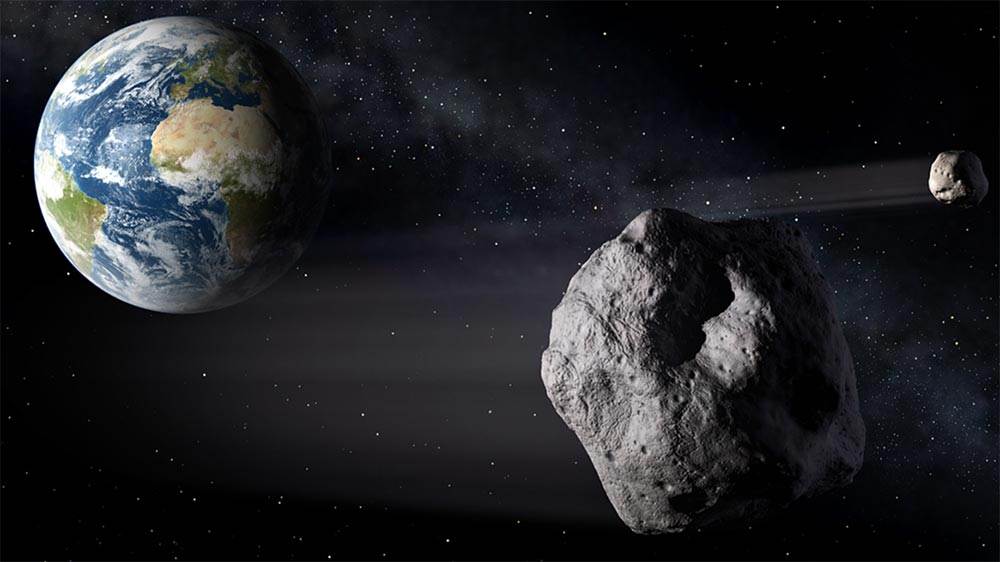
  • Asteroids can make us extinct (the threat).
  • Asteroids can make us rich and provide homes for trillions of people (the promise).

The Promise

There are vast numbers of asteroids in near-Earth orbits, some of which are easier to access than the Moon. The potential mineral wealth of these asteroids is so great that huge profits could be made once we can start mining them for materials to be sold to markets on Earth. Like space solar power, this is one of the potential revenue sources for the large startup costs for the first space settlements.

Asteroids can also be an enormous boon to orbital settlements. Orbital settlements must import their materials from either the Moon or asteroids. Diverting a few small (30-70 meter diameter) asteroids into Earth orbit could supply all the materials needed for early orbital settlement development.

While early orbital settlements may well be in Earth orbit, eventually humanity will spread out across the solar system. Then asteroids become prime targets for new settlements. Hollowing out a large, solid asteroid and building homes inside has great appeal. Such a settlement will have ample materials in the form of the asteroid itself, and the large mass of the asteroid provides immediate and substantial radiation protection. With a little care radiation levels could be less than on Earth.

Settlement of a large asteroid could start with a relatively small tunnel, providing a home for workers that could be gradually extended over time to build large open spaces and wonderful living areas with a complex geometry, providing endless, safe exploration possibilities for the children.

While some asteroids are believed to be solid enough to be hollowed out for living space, others are known to be 'rubble-piles,' barely held together by their weak gravity. While such asteroids cannot be hollowed out for living in, they are much easier to mine to provide materials for large numbers of orbital settlements.

The vast material resources of the asteroid belt beyond Mars may eventually provide home for the bulk of humanity.

The Threat

If we don't do something, sooner or later Earth will be hit by an asteroid large enough to kill all or most of us. That includes the plants and animals, not just people. Maybe this won't happen for millions of years. Maybe in 15 minutes. We don't know.

We have been warned. On 23 March 1989, asteroid 1989FC (with the potential impact energy of over 1000 megatons, roughly the equivalent a thousand of the most powerful nuclear bombs) missed Earth by about six hours [Freedman 1995]. We first saw this fellow after closest approach. If 1989FC had come in six hours later most of us would have been killed with zero warning. We are hit by thousands of smaller asteroids every year and we don't see any of them before the collision.

In October of 1990 a very small asteroid struck the Pacific Ocean with a blast about the size of the first atomic bomb (the one that leveled Hiroshima, Japan, killing roughly 200,000 people in seconds). If this asteroid had arrived ten hours later it would have struck in the middle of more than a million U.S. and Iraqi soldiers preparing for war. How would America have reacted to what looked like an Iraqi nuclear attack? Hiroshima-sized explosions due to asteroids actually occur in the Earth's atmosphere about once a month [Lewis 1996b], but are seldom seen because most of the Earth is unpopulated.  The data comes from Air Force satellites designed to look for nuclear explosions.

In 1908 a small asteroid (perhaps 50 meters across) hit Tunguska, Siberia and flattened 60 million trees. That asteroid was so small it never even hit the ground, just exploded in mid-air. If it had arrived four hours and fifty-two minutes later it could have hit St. Petersburg [Lewis 1996b]. At the time St. Petersburg was the capital of Russia with a population of a few hundred thousand. The city would have ceased to exist. As it was, dust from the blast lit up the skies of Europe for days. Asteroid strikes this size probably happen about once every hundred years. However, this is just an average. Just because we got hit once doesn't mean we're safe for another hundred years. Indeed, there was another Tunguska-class strike in the Brazilian rain forest on 13 August 1930 [Lewis 1996b].

There are about 1,000 asteroids a kilometer or more in diameter that cross Earth's orbit (the path Earth takes around the Sun). About a third of these will eventually hit Earth [Lewis 1996a]. An asteroid strike this large can be reasonably expected to kill a billion people or so, depending on where it hits. A strike in China or India would kill more, in Antarctica less. Even a strike in the ocean would create a tsunami so enormous most people living near the coast would be drowned. A strike of this size is expected about once every 300,000 years or so.

It's not just Earth. In 1178 our Moon was hit by an asteroid creating a 120,000 megaton explosion (about six times the force of Earth's entire atomic arsenal). The collision dug a 20 km (12 mile) crater. This strike was recorded by a monk in Canterbury, England. We are extremely lucky it didn't hit us. The Moon is a smaller target and has much less gravity to attract an impactor. If a 120,000 megaton blast had hit the Earth our history would have been dramatically different. We're just lucky that one hit the Moon instead.

The most recent large strike also missed Earth. In July 1994 the comet Shoemaker-Levy 9 plowed into Jupiter. The comet broke up into roughly 20 large pieces before contact, but when the pieces hit they left a string of enormous explosions clearly visible to our telescopes. The scale of the destruction was staggering. Each impact was the equivalent of about 10 million megatons of TNT.

Sixty-five million years ago a huge asteroid several kilometers across slammed into the Yucatan Peninsula in Mexico. This is the event that caused the extinction of the dinosaurs (and many other species). The explosion was the equivalent of about 200 million megatons of dynamite, about the equivalent of all 20 pieces of Shoemaker-Levy. The blast turned the air around it into plasma — a material so hot electrons are ripped from the atomic nucleus and molecules cannot exist. This is the stuff the Sun is made of. Enormous quantities of red-hot materials were thrown into space, most of which rained down worldwide burning literally the entire planet to a crisp. Anything not underground or underwater was killed. This scenario has been repeated over and over, perhaps once every 100 million years or so. Each collision killed up to 95% of all species on Earth. As many as two-thirds of all species that ever existed may have been terminated by asteroids hitting the Earth.

We know about the asteroid that killed the dinosaurs because we found the crater. But what happens when an asteroid hits the ocean? After all, oceans cover two-thirds of the Earth's surface, and most asteroid strikes are in water. Unless the asteroid is very large there won't be a crater. However, if you drop a rock into a lake it makes waves. The larger the rock the bigger the wave. Drop a 400 meter (four football fields) diameter asteroid into the Atlantic Ocean and you get a tsunami 60 meters (yards) high [Willoughby and McGuire 1995].

The only way to eliminate the threat of asteroids is to detect them and divert them. Right now we depend on a trickle of government funding for this. Detection of Earth-threatening rocks is very far from complete. At the present rate it will take years before we find just 90% of them.

A vigorous space settlement civilization based on asteroidal materials would have enormous economic incentives to find and utilize every asteroid passing anywhere near Earth. They would be found, diverted, and mined for their materials. This would defuse the threat, make an awful lot of people extremely rich, and provide lovely homes to even more people.

What a deal.

See also:
Asteroid Mining: Key to the Space Economy, by Mark Sonter
The Technical and Economic Feasibility of Mining the Near-Earth Asteroids
Resources of Near-Earth Space, Part III: Near-Earth Objects (complete online book)


References

[Freedman 1995] George Friedman, "The Increasing Recognition of Near-Earth-Objects (NEOs)," Space Manufacturing 10: Pathways to the High Frontier, Proceedings of the Twelfth SSI-Princeton Conference, 4-7 May 1995, edited by Barbara Faughnan, American Institute of Aeronautics and Astronautics (AIAA), pages 157-164.

[Lewis 1996a] J. S. Lewis, Mining the Sky: Untold Riches from the Asteroids, Comets, and Planets, Helix Books, Addison-Wesley Publishing Company, Inc. [Review] [Buy from Amazon]

[Lewis 1996b] J. S. Lewis, Rain of Iron and Ice: The Very Real Threat of Comet and Asteroid Bombardment, Helix Books, Addison-Wesley Publishing Company, Inc. [Buy from Amazon]

[Willoughby and McGuire 1995] Allan J. Willoughby and Melissa L. McGuire (1995), "Adroitly Avoiding Asteroids! Clobber, Coax or Consume?" Space Manufacturing 10: Pathways to the High Frontier, Proceedings of the Twelfth SSI-Princeton Conference, 4-7 May 1995, edited by Barbara Faughnan, American Institute of Aeronautics and Astronautics (AIAA), pages 103-113.

Links


NSS Logo   
1620 I (Eye) Street NW, Suite 615, Washington, DC 20006
Tel: (202) 429-1600 -- FAX: (202) 463-8497 -- E-mail: nsshq@nss.org
Direct questions about membership matters to: members@nss.org

Copyright © 1998-2008, National Space Society

   Powered By CyberTeams

X     Last updated on Thu, Jul 24, 2008 at 13:17:44
